
Generative Engine Optimization (GEO) is the practice of making your content easy for AI search tools, such as Google AI Overviews, ChatGPT, Perplexity and Gemini, to find, understand, quote and cite in the answers they generate. Where classic SEO aims to rank a page in a list of blue links, GEO aims to get your brand and facts included inside the answer itself.
This guide explains what GEO is, how it differs from SEO and Answer Engine Optimization (AEO), what the research says, and a practical checklist you can apply to your website this week. It is written for business owners and marketers in Pakistan and abroad who want to stay visible as search shifts toward AI-generated answers.
Key takeaways
- GEO is about being cited in AI answers, not only ranked in a list of links.
- Google states there is no special markup or extra requirement for AI Overviews and AI Mode. The page must be indexed and eligible to show with a snippet, so strong SEO fundamentals come first.
- A Seer Interactive study found organic click-through rate on queries with an AI Overview was about 2.1% when the page was cited and about 0.9% when it was not.
- The practical levers are clear answers, original data, named sources, entity clarity and technical accessibility.
What is Generative Engine Optimization (GEO)?
GEO is the work of improving how often, and how favourably, generative search engines use your content when they compose an answer. A generative engine is any system that retrieves information from the web and uses a large language model (LLM) to write a summary or direct answer for the user. Examples include Google AI Overviews and AI Mode, ChatGPT search, Perplexity, Microsoft Copilot and Gemini.
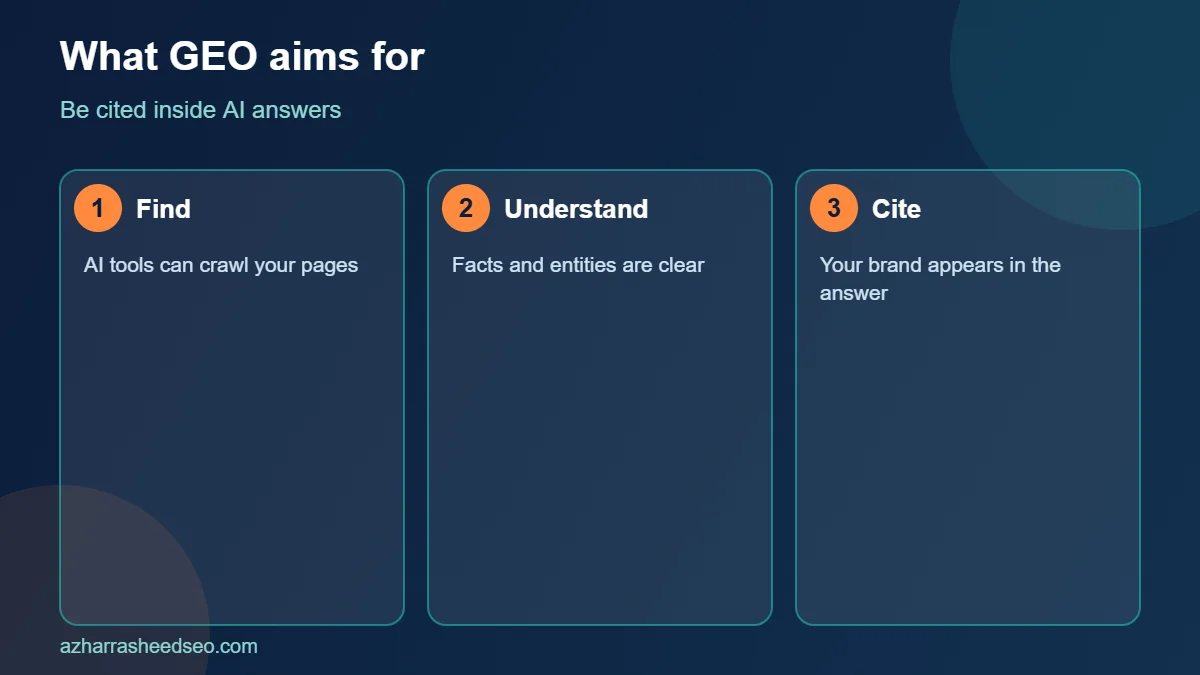
The term was popularised by a 2023 research paper, “GEO: Generative Engine Optimization” by Pranjal Aggarwal and co-authors (arXiv:2311.09735). The authors proposed GEO as a framework for helping creators improve their visibility in generative engine responses, and reported that well-chosen optimization methods could boost visibility by up to 40% in their experiments. They also noted that what works varies by topic area, so there is no single formula that fits every site.
GEO vs SEO vs AEO: what is the difference?
The three terms overlap, and in practice the same good content supports all of them. The difference is the target outcome.
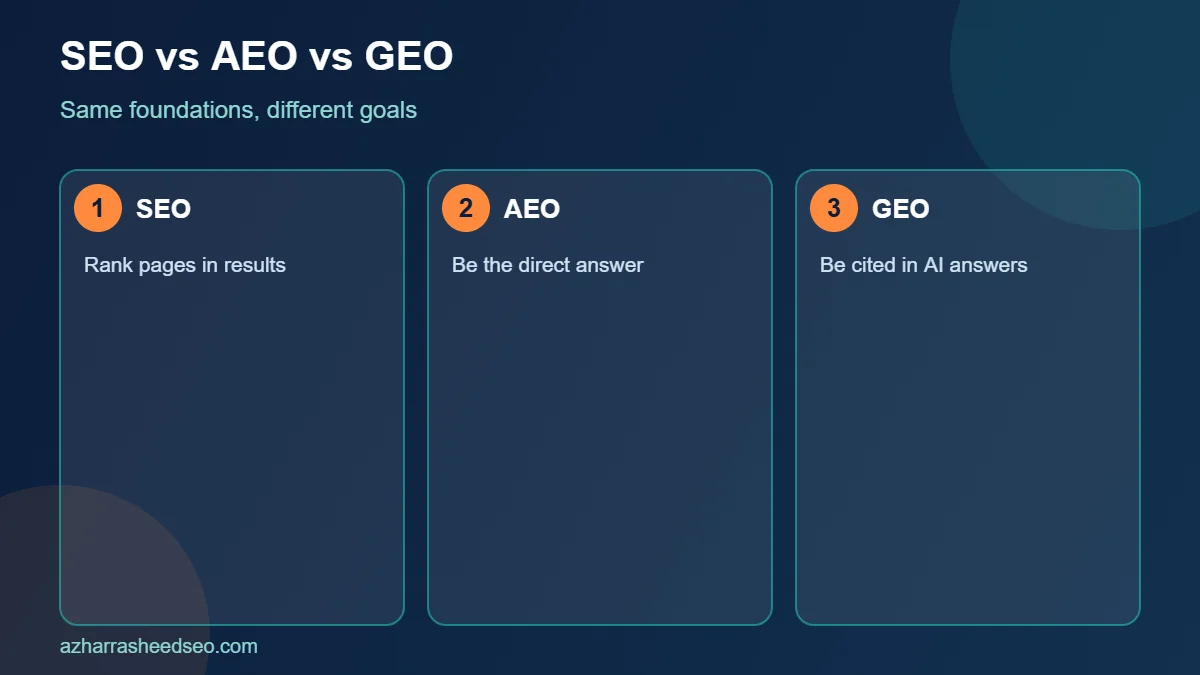
| Approach | Main goal | Where it shows up | Typical success signal |
|---|---|---|---|
| SEO | Rank pages in search results | Google and Bing result pages | Rankings, organic clicks |
| AEO | Be the direct answer to a specific question | Featured snippets, voice answers, answer boxes | Snippet ownership, answer inclusion |
| GEO | Be cited or mentioned in AI-written answers | AI Overviews, AI Mode, ChatGPT, Perplexity, Gemini | Citations, brand mentions, referral visits |
If you are new to the answer-focused side of this, read our step-by-step AEO guide first, then come back here for the generative layer.
Why GEO matters now
AI-generated answers change what a “result” is. A user can get a full answer without visiting any site, so the question becomes whether your brand appears in that answer. The data so far points in two directions:
- Being cited helps. In Seer Interactive’s analysis of 53 brands, 5.47 million queries and 2.43 billion impressions (January 2025 to February 2026), organic CTR was about 3.3% on queries with no AI Overview, about 2.1% when an AI Overview cited the page, and about 0.9% when it appeared without citing the page (reported by Search Engine Land).
- The query type matters. The same study found AI Overviews appeared on roughly 95% of comparison queries and 86% of question queries, but only about 36% of informational queries and 5% of transactional ones. Question-style and comparison content is where GEO matters most.
For a local service business, this means two things. Your educational content needs to earn citations, and your commercial pages still need classic SEO and local SEO to capture buyers who are ready to act.
How AI search engines choose what to cite
The exact selection logic is not public, and it differs between platforms. What is documented comes from Google: its guidance on AI features in Search says there are no additional requirements to appear in AI Overviews or AI Mode, and no special schema.org markup is needed. A page must be indexed and eligible to be shown in Google Search with a snippet. Google also recommends allowing crawling, linking pages internally, offering a good page experience, keeping important content in text form, and keeping structured data consistent with the visible text.
In other words, GEO is not a replacement for SEO. It sits on top of it. A page that cannot be crawled, indexed or understood will not be cited by any AI system that relies on search results. If you are not sure your foundation is sound, start with our local SEO guide and the technical checklist linked later in this article.
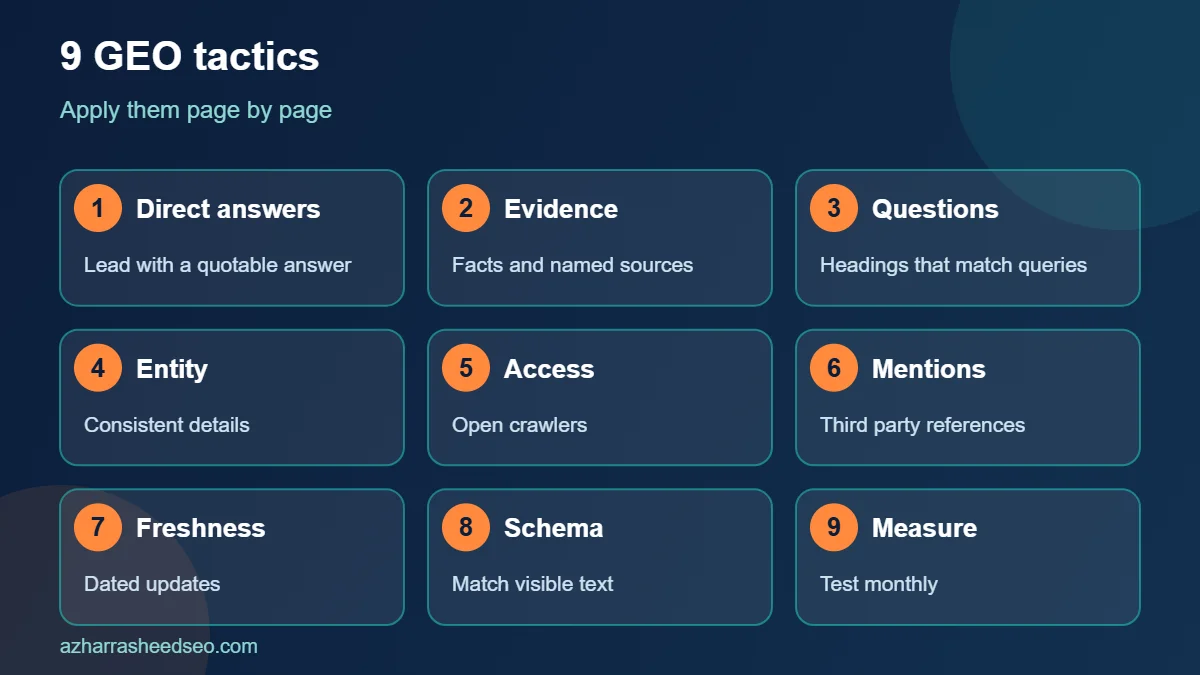
9 practical GEO tactics you can apply today
1. Lead with a direct, quotable answer
Put a clear one- to three-sentence answer directly under each question-style heading, before the nuance. AI systems extract passages, and a self-contained answer is easier to lift accurately than a point buried in the fourth paragraph.
2. Add original facts, numbers and named sources
In the GEO paper’s tests, strategies such as adding citations, quotations and statistics were among the better performers. Whatever the exact ranking for your niche, the principle is sound: specific, sourced claims give a model something concrete to attribute. Link to primary sources and state dates, so a claim can be checked.
3. Structure pages around real questions
Use headings that mirror how people ask. Include comparison tables, short step lists and definitions. Keep each section focused on one idea so it can stand alone when extracted.
4. Make your entity unmistakable
Models need to know who is speaking. Keep your business name, address, phone number, services and author details consistent across your website, Google Business Profile, LinkedIn and directories. Add an author bio with real credentials on every article, and an About page that states what you do and where.
5. Keep technical access open
Check that robots.txt, your CDN and your firewall do not block the crawlers you want. Make sure important content is in HTML text, not hidden behind scripts or images. Fix indexing problems before anything else. Our technical SEO checklist walks through each check.
6. Earn mentions beyond your own site
AI answers often draw on pages that discuss a brand, not only the brand’s own pages. Digital PR, genuine reviews, industry directories, podcasts and guest articles all create third-party references that reinforce who you are and what you are known for.
7. Keep content fresh and dated
Show a published and last-updated date, and refresh statistics regularly. Outdated numbers are a reason for a system to prefer a newer source.
8. Use structured data to match what is on the page
Google says no special markup is required for AI features, but accurate Article, Organization, LocalBusiness and Person markup helps search systems understand the page. The rule is consistency: markup must reflect the visible content. Note that Google has stopped showing FAQ rich results in Search (documentation updated June 2026), so add FAQ sections for readers and answer extraction, not for a rich-result badge.
9. Measure what you can
Track branded search volume, referral traffic from AI platforms in GA4, and manual checks of target questions in each AI tool. Keep a simple log of prompts, whether you were cited, and which page was used. Treat the numbers as directional, since AI answers vary from one run to the next.
A simple GEO workflow for small businesses
- List 15 to 20 real customer questions from calls, WhatsApp chats and Search Console queries.
- Check each question in Google, ChatGPT and Perplexity. Note who is cited.
- Update or create one page per question with a direct answer, evidence and a clear next step.
- Strengthen entity signals: author bios, consistent business details, reviews.
- Request mentions from local publications, partners and directories.
- Re-test monthly and record changes.
Common GEO mistakes
- Chasing tricks. Hidden text, prompt-injection snippets or mass-produced thin pages do not build trust, and they risk spam actions from search engines.
- Ignoring SEO basics. Slow, unindexed or duplicate pages rarely get cited.
- Publishing unsourced claims. Without evidence, a model has little reason to attribute a statement to you.
- Treating GEO as a one-time project. AI answers change often, so monitoring matters.
Generative engine optimization for small businesses in Pakistan
Generative engine optimization is not only for large brands. A clinic in Lahore, a law firm in Karachi or an agency in Islamabad can all use generative engine optimization to appear when people ask AI tools for recommendations. The reason is simple: generative engine optimization rewards clear, trustworthy information, and small businesses can often explain their services more clearly than big competitors.
Start generative engine optimization with your own facts. Write down your services, your service areas, your prices where possible, your opening hours and your team’s qualifications. Publish them in plain text on your website. Strong generative engine optimization always begins with accurate, easy-to-find information that a model can quote without guessing.
How to prioritize pages for generative engine optimization
You cannot rewrite every page at once, so prioritize. For generative engine optimization, rank your pages by three questions. Which pages answer questions people ask AI tools? Which pages already get impressions in Search Console? Which pages support a service you want to sell? Pages that score well on all three are the best place to start generative engine optimization.
- Definition pages: pages that explain “what is” and “how to” topics are natural targets for generative engine optimization.
- Comparison pages: pages that compare options or providers are often cited, so include honest tables.
- Local service pages: pages that state who you serve and where help generative engine optimization for local queries.
- Proof pages: case studies, reviews and credentials strengthen trust signals for generative engine optimization.
Measuring generative engine optimization results
Results from generative engine optimization are harder to measure than rankings, but they can be tracked. Keep a simple sheet of the questions you want to be cited for. Once a month, ask each question in Google, ChatGPT and Perplexity, and record whether your brand or page appears. Add branded search trends from Search Console and referral visits from AI tools in your analytics. These three numbers together give a fair picture of generative engine optimization progress.
Be careful not to over-read a single result. AI answers vary from run to run, so generative engine optimization needs a monthly pattern, not a one-day verdict. If your citations rise over three months, the work is paying off. If they stay flat, review your content depth, your sources and your third-party mentions.
Why generative engine optimization still depends on SEO
Many people ask whether generative engine optimization replaces SEO. It does not. Search engines still crawl, index and rank pages, and many AI answers draw on those pages. Google’s own documentation on AI features in Search confirms that normal SEO best practice applies. So treat generative engine optimization as a layer on top of strong technical SEO, helpful content and clear entity signals.
In practice, this means you fix crawling and indexing first, publish helpful pages second and then apply generative engine optimization tactics such as direct answers, cited facts and consistent author information. Done in that order, generative engine optimization compounds the value of the SEO work you already do, and it prepares your site for whatever AI search tools appear next.
A 30-day generative engine optimization starter plan
In week one, list 20 customer questions and test them in each AI tool. In week two, rewrite your five most important pages with direct answers and named sources. In week three, improve your author pages, About page and business profiles so your entity is clear. In week four, request mentions from partners and directories, and record your first monthly results. Repeat this cycle, and generative engine optimization becomes a steady habit instead of a one-off project.
Frequently asked questions
What does GEO stand for in SEO?
GEO stands for Generative Engine Optimization. It means optimizing content so that AI-powered search tools can retrieve it and cite it in generated answers.
Is GEO different from AEO?
They overlap. AEO focuses on being the direct answer to a question in answer boxes, snippets and voice results. GEO focuses on being cited or mentioned in answers written by large language models. The same clear, well-sourced content supports both.
Do I need special schema markup to appear in Google AI Overviews?
No. Google states there is no special structured data or additional requirement for AI Overviews and AI Mode. The page needs to be indexed and eligible to appear in Search with a snippet.
Can GEO replace SEO?
No. AI search tools still depend on crawlable, indexable, trustworthy pages. SEO remains the foundation, and GEO builds on it.
How long does GEO take to show results?
There is no fixed timeline. Changes to existing pages can be picked up as pages are recrawled, which may take days or weeks, while building third-party mentions and brand recognition takes months. Track progress monthly.
How can I check whether AI tools cite my website?
Search your target questions in Google (look for AI Overviews), ChatGPT search and Perplexity, and note the cited sources. Also review GA4 referral traffic from AI platforms and watch branded search trends.
Next steps
Start with one high-value page: add a direct answer, two or three cited facts, a visible author bio and an updated date, then test it in each AI tool. If you want a specialist to audit your site for AI search readiness, request a free SEO audit or browse our guide to ranking in Google AI Overviews.
Sources: Aggarwal et al., GEO: Generative Engine Optimization (arXiv:2311.09735); Google Search Central, AI features and your website; Search Engine Land, summary of Seer Interactive’s AIO CTR study. Last updated 28 October 2026.
About the author: Azhar Rasheed Qureshi is an SEO specialist based in Pakistan who works on SEO, AEO, GEO, local SEO and WordPress development for local and international businesses. Connect on LinkedIn.