
A local SEO audit is a step-by-step review of the signals that decide whether your business appears in Google Maps, the local pack and “near me” results: your Google Business Profile, your citations, your reviews, your website and your local rankings. This guide shows you how to run a local SEO audit in 10 steps, with a free scorecard you can copy and a clear order of fixes.
If your phone is not ringing as often as it should, a local SEO audit shows why. Perhaps your profile has the wrong category, your address differs across directories, your reviews are thin or your website has no page for the city you serve. Use this audit alongside our local SEO checklist and our complete local SEO guide.
Key takeaways
- Google says local results are based mainly on relevance, distance and prominence, so a local SEO audit should test all three.
- Start the local SEO audit with your Google Business Profile, because it is the main driver of local pack visibility.
- Check that your name, address and phone number are identical across your profile, website and directories.
- Finish with a prioritised action plan, not just a list of problems.
What is a local SEO audit?
A local SEO audit is a structured health check of everything that affects your visibility for local searches. It looks at your business profile, location pages, citations, reviews, local links, on-page content and technical health, and compares them with the competitors who rank above you. The result is a prioritised list of fixes.
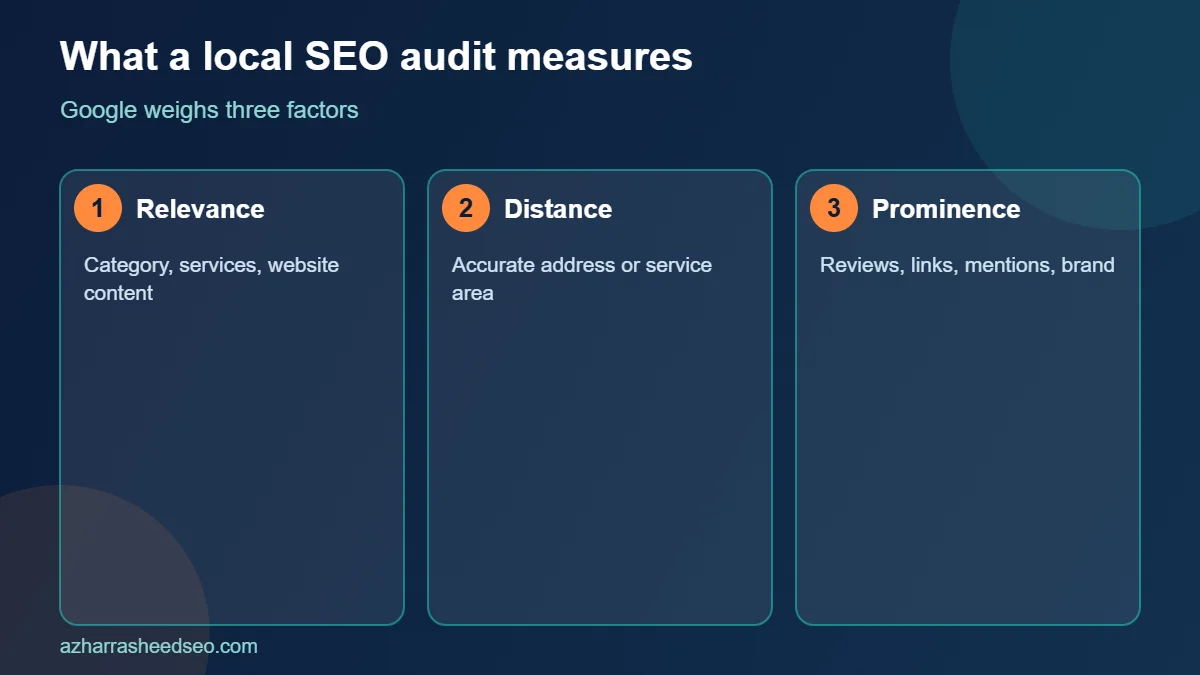
A local SEO audit differs from a general SEO audit in one important way: it centres on location. Google decides which businesses to show by weighing how well a profile matches the search, how close it is to the searcher and how well known it is. Google describes these factors in its guide on improving your local ranking. A good local SEO audit measures your strength on each one.
When should you run a local SEO audit?
- Before starting local SEO for a new business or client.
- When calls, direction requests or website clicks from your profile fall.
- After moving, rebranding or changing your phone number or hours.
- When a new competitor starts appearing in the local pack.
- Twice a year as routine maintenance.
What you need before you start the local SEO audit
Gather these items first, so the local SEO audit runs smoothly:
- Access to your Google Business Profile, Google Search Console and Google Analytics.
- Your official business name, address, phone number, website and hours.
- A list of your main services and the areas you serve.
- The names of three to five local competitors that rank above you.
- A spreadsheet to record findings, with columns for check, result, priority and fix.
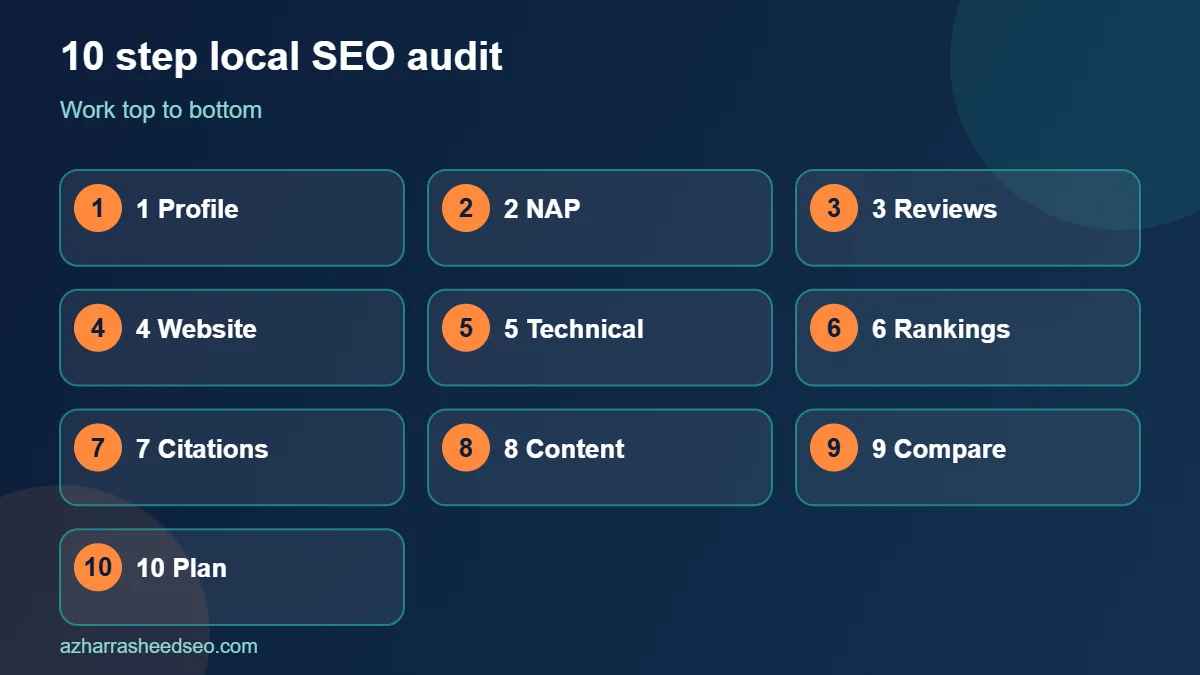
Step 1: Audit your Google Business Profile
The profile is the first stop of any local SEO audit. Open your listing and check each section against Google’s guidelines for representing your business:
- Ownership and verification: the profile is verified and you control it. There is only one profile per location.
- Business name: it matches your real-world signage and branding, without added keywords or location words.
- Primary category: it is the most specific category that describes your main service, and secondary categories are relevant.
- Address or service area: the address is a real, staffed location, or the address is hidden with a service area for travelling businesses.
- Hours: regular and special hours are correct, including holidays such as Eid.
- Services and products: each is listed with a clear description.
- Photos: recent, original images of the exterior, interior, team and work.
- Description: accurate and free of links, prices and promotions.
For a deeper walkthrough of each field, read our Google Business Profile optimization guide.
Step 2: Audit name, address and phone consistency
Search engines compare your business details across the web to decide whether they can trust them. In this part of the local SEO audit, search for your business name and phone number, and list every directory, social profile and listing site that shows your details. Check for these problems:
- Different business names or abbreviations.
- Old addresses, suite numbers or street spellings.
- Old phone numbers or tracking numbers used in some places only.
- Duplicate listings for the same location.
- Listings that show the business as closed or moved.
Record each mismatch and its URL. Fix the most visible listings first, such as Google, Bing, Apple Maps, Facebook and major local directories in your market.
Step 3: Audit your reviews
Reviews influence prominence and clicks, so every local SEO audit should include them. Check these points:
- The total number of reviews and your average rating compared with the top three competitors.
- How recent your reviews are. A steady flow shows an active business.
- Whether you reply to reviews, both positive and negative.
- Any review policy problems, such as incentives or suspected fake reviews.
- Whether customers mention your key services and locations in their own words.
Never buy reviews or offer rewards for them, since Google’s policies prohibit fake and incentivised reviews. Instead, add a review request step to your customer process, with a direct link and a QR code.
Step 4: Audit your website for local relevance
Your website supports the profile with relevance and trust signals. In your local SEO audit, review the following:
- Location and service pages: each main service and each main city or area has its own page with unique, useful content.
- Title tags and headings: they include the service and the location naturally. See our on-page SEO checklist for the full list of checks.
- Contact details: your address, phone number and hours are visible, crawlable text that matches your profile.
- Embedded map and directions: they make it easy for customers to find you.
- Proof: testimonials, case studies and photos from real local jobs.
- Schema: LocalBusiness markup that matches the page. See our guide to schema markup.
Step 5: Run a technical check of the local website
A local SEO audit also needs a quick technical review, because slow or broken pages lose customers. Check that the site uses HTTPS, loads fast on mobile, has a clean XML sitemap, has no accidental noindex tags and has no broken links on the pages that matter. For a full process, follow our technical SEO audit guide. Most local visitors use phones, so test your contact page on a real mobile device and make sure the call and directions buttons work.
Step 6: Check your local rankings properly
Local rankings change by searcher location, so checking from your desk is misleading. In this step of the local SEO audit, test your main keywords in several ways:
- Search your main service plus city, such as “dentist in Lahore”, from a private browser window and note whether you appear in the local pack and which position you hold.
- Repeat the search from different areas of the city, or ask staff and friends in those areas to check, because distance affects results.
- Use a local rank tracking tool with a geographic grid if you have the budget. It shows how your visibility changes block by block.
- Record the top three competitors for each search.
Also open the Performance data in your profile to see the queries that trigger your listing, along with calls, direction requests and website clicks. This is the ground truth for what customers actually do.
Step 7: Audit citations and local links
Prominence grows when trusted local sources mention and link to your business. For this part of the local SEO audit, review where you are listed and linked:
- Major directories and data aggregators relevant to your country.
- Industry and association directories, chamber of commerce pages and local business listings.
- Local news mentions, sponsorships, events and partner websites.
- Links to your site from nearby relevant businesses.
Compare your list with the competitors you chose earlier. Gaps show you where to build new, high-quality mentions. Focus on relevance and trust, not on the number of listings.
Step 8: Review your content and local topics
Helpful local content builds relevance and earns links. In the local SEO audit, check whether you have pages or posts that answer the questions customers ask. Examples include pricing guides, how-to articles, FAQs about your service and pages about local regulations or events. Make sure each page has a clear answer at the top, a visible author and a recent update date. Content that answers real questions is also more likely to be quoted in AI answers, as described in our guide to ranking in Google AI Overviews.
Step 9: Benchmark against competitors
A local SEO audit makes more sense when you compare yourself with the businesses that outrank you. For each of your three to five competitors, record their primary category, review count and rating, photo count, website pages for the service and area and visible mentions or links. The gaps show where to invest first. If a competitor has 300 reviews and you have 20, review generation is your first priority. If a competitor has a dedicated page for each area you serve and you do not, build location pages first.
Step 10: Build your prioritised action plan
The last step of a local SEO audit turns findings into work. Score each issue by impact and effort, then sort it into three groups.
| Priority | Typical issues | When to fix |
|---|---|---|
| Fix now | Wrong category, wrong hours, duplicate profiles, suspended or unverified profile, wrong phone number | This week |
| Fix next | Missing location pages, few reviews, inconsistent citations, weak titles | Within 30 days |
| Build over time | Local links, content hub, photo and post routine, review growth | Within 90 days and ongoing |
Assign an owner and a date to each item, and recheck results after 30 and 90 days.
Free local SEO audit scorecard
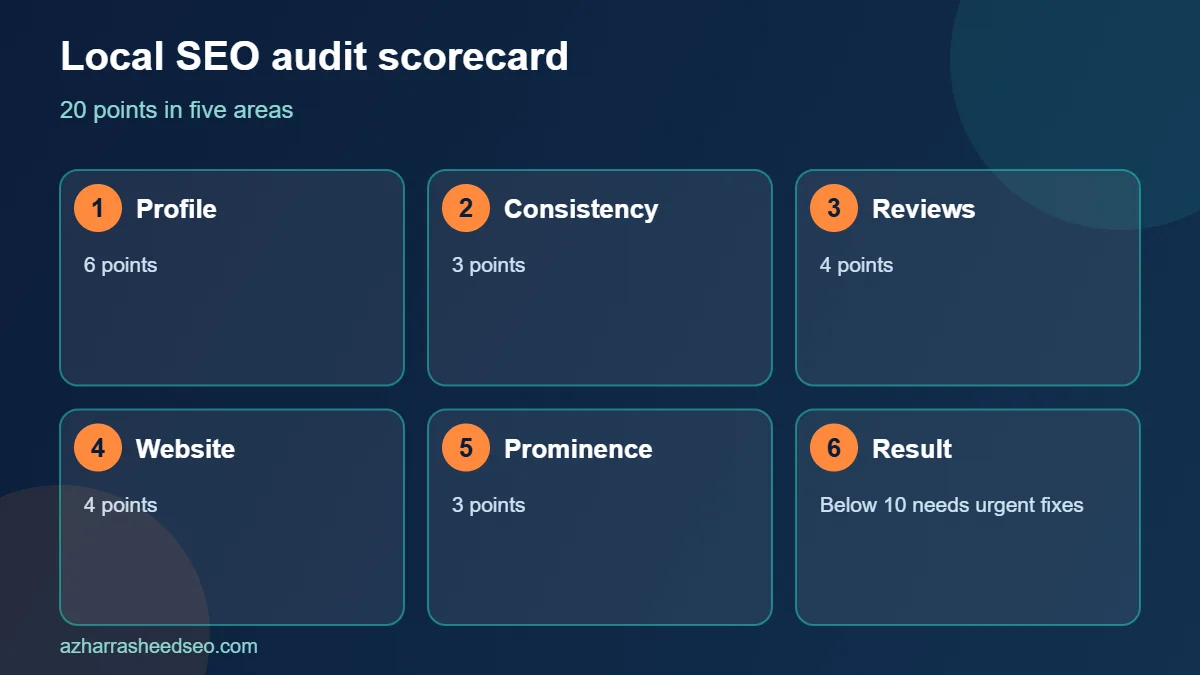
Copy this scorecard into a spreadsheet. Give each line one point when it passes, and add up the total out of 20.
- Profile (6 points): verified, one profile, real name, specific primary category, correct hours, services added.
- Consistency (3 points): same name, address and phone on the website, profile and top directories.
- Reviews (4 points): at least as many reviews as the top competitor average, rating above 4, reviews in the last 30 days, replies to most reviews.
- Website (4 points): service pages, location pages, local schema, fast mobile contact page.
- Prominence (3 points): relevant directory listings, local links or mentions, brand searches growing.
A score under 10 means urgent fixes. Between 10 and 15, you have a base to improve. Above 15, focus on competing for reviews, links and content.
Local SEO audit tools
- Google Business Profile Performance: searches, calls, directions and website clicks.
- Google Search Console: queries, pages, positions and indexing.
- Google Analytics: traffic and conversions from local landing pages.
- PageSpeed Insights: mobile speed.
- Rich Results Test: structured data checks.
- A local rank tracker: optional, to view rankings on a map grid.
- A spreadsheet: to hold findings, competitor data and action items.
Common local SEO audit mistakes
- Only checking rankings. Rankings are the result. A local SEO audit must find the causes.
- Auditing from one location. Local results vary by place, so test from several points.
- Ignoring the guidelines. Keyword-stuffed names and virtual offices risk suspension.
- Stopping at the report. Value comes from fixing and re-measuring.
- Copying competitors blindly. Use their data as a benchmark, but follow Google’s rules.
Local SEO audit for service-area businesses
If you travel to customers, such as a plumber, an electrician or a cleaning company, adjust the local SEO audit. Confirm the address is hidden and the service area is set to the areas you really serve. Check that service pages exist for each major area and that they carry real examples, photos and reviews from those areas. Rankings will often depend more on where customers search from, so test several neighbourhoods. Do not create fake addresses to look present in many cities, because that breaks Google’s rules and can cause suspension.
Frequently asked questions
What is a local SEO audit?
A local SEO audit is a review of the factors that affect how your business ranks in Google Maps and local search results, including your profile, citations, reviews, website and competitors, ending with a prioritised plan.
How long does a local SEO audit take?
A small single-location business can be audited in two to four hours. Multi-location businesses take longer, because each location needs its own checks.
How often should I run a local SEO audit?
Run a full local SEO audit twice a year, and check your profile, reviews and rankings monthly. Run one sooner after a move, rebrand or sudden drop in calls.
Can I do a local SEO audit myself?
Yes. Using your Google Business Profile, Search Console, a spreadsheet and the steps in this guide, most business owners can complete a basic local SEO audit. An expert helps with complex, multi-location or competitive markets.
What should I fix first after a local SEO audit?
Fix profile errors first, such as category, name, hours and duplicates, then citation inconsistencies, then build reviews and location pages.
Does a local SEO audit cost money?
You can run one for free with the tools above. Paid tools and professional audits add data such as grid rank tracking and competitor link analysis.
Next steps
Open your Google Business Profile today and run through Step 1 of this local SEO audit. If you would like an expert to review your business, request a free SEO audit or read how to choose the best SEO expert in Pakistan.
Sources: Google Business Profile Help, Improve your local ranking; Google Business Profile Help, Guidelines for representing your business. Last updated 28 October 2026.
About the author: Azhar Rasheed Qureshi is an SEO specialist based in Pakistan who works on SEO, AEO, GEO, local SEO and WordPress development for local and international businesses. Connect on LinkedIn.